The Automation Paradox
Who Really Gets Hurt When AI Takes Over?
Most coverage of AI and jobs focuses on which occupations are at risk. This project asks a harder question: which workers are actually unable to adapt when displacement happens?
Using automation probability scores (Frey & Osborne, 2013), BLS employment projections through 2034, and the ILO’s 2025 GenAI Exposure Index, the analysis finds that 144 occupations — nearly 24% of the matched dataset — combine high automation exposure with wages and education too low to support any transition. Automation risk and job loss are correlated (r = −0.41) but not the same thing. The gap between them is adaptive capacity, and it maps almost perfectly onto existing economic inequality.
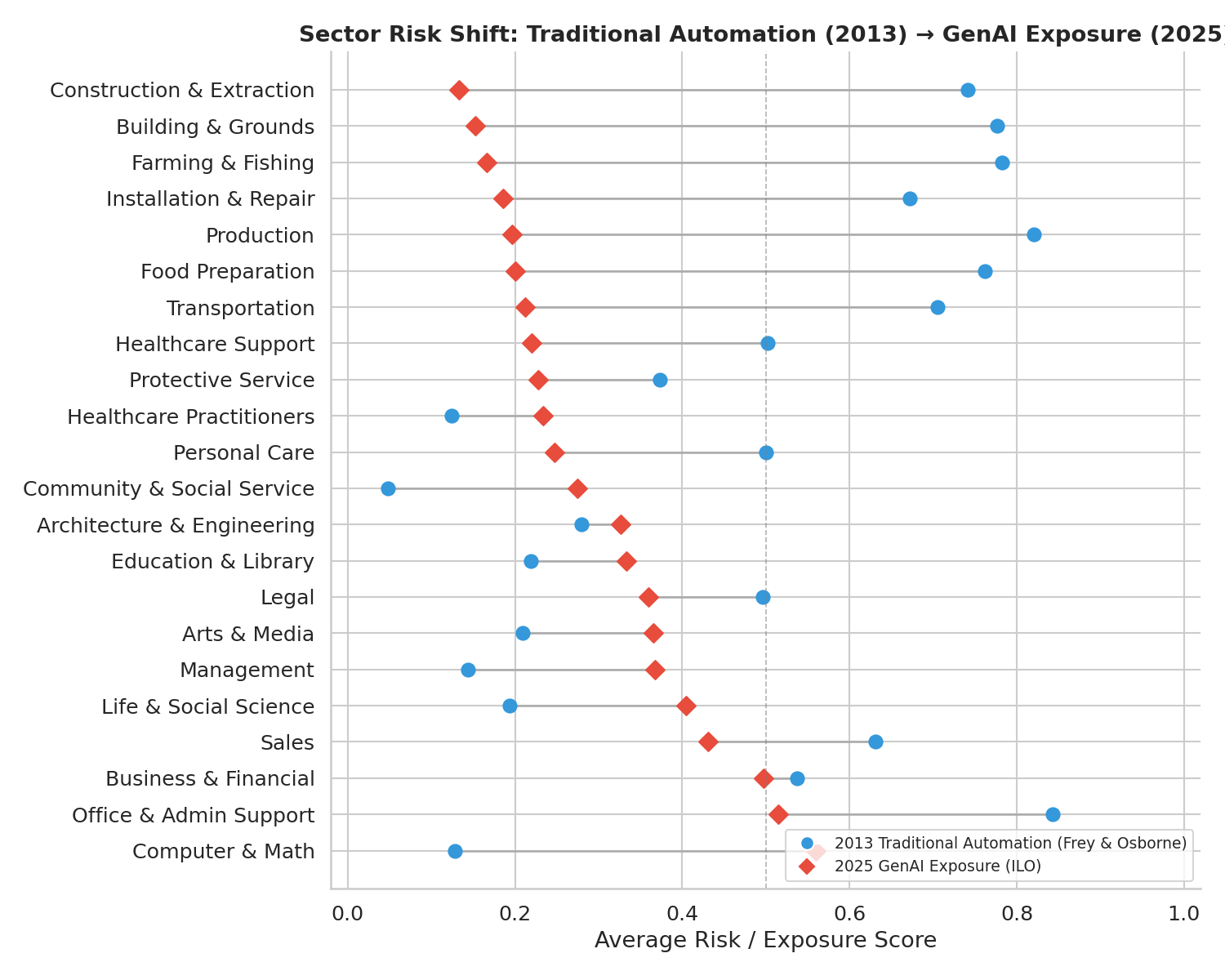
A second finding complicates the picture further: the risk map has shifted. Sectors that 2013 models flagged as near-certain automation targets score among the lowest on GenAI exposure today. Knowledge work — writers, analysts, mathematicians — is newly in the crosshairs.
Data sources:
- Frey & Osborne (2013) — automation probability scores, 702 US occupations
- BLS Employment Projections 2024–2034 — US Department of Labor
- ILO GenAI Exposure Index — Gmyrek et al. (2025), ILO Working Paper 140